Table of contents
Open Table of contents
The Ditch
Years ago, I had a peer who didn’t do their darned job. We had the same job and title, and our job was simple: we completed tasks that came in through a queue of tickets that were assigned to our team. Different tickets had different categories and levels of priority, based upon which different timeliness metrics had to be met. This work was highly visible in a dashboard available to everyone on the team, as was who was completing the work (or “crushing the queue”). Every month, they bottomed out the charts. I, on the other hand, topped them out.
Then, one day, they were gone. Not because they were fired or left the company — but because they were promoted out of our team entirely!
At the moment, this didn’t strike me as fair. I did what I was told. They didn’t. They got rewarded for it. What gives?
The simplest answer to that question is that they simply worked on more important things. It wasn’t always obvious that that was what they were doing. Sometimes, they simply talked to another person on another team about a shared problem they were having. Other times, they talked about baseball. Once, they invested a ton of time into a harebrained scheme on something or other that ultimately went nowhere. “What a waste of time!” I thought.
Still, there were successes. One day, while crushing the queue, I noticed that the rhythm of work trickling in slowed. One of our most common, recurring ticket types suddenly… stopped. When I asked my supervisor about it, they said that my peer had worked with the team from which those tickets originated, to find a different, better way of doing things that empowered that team to more easily and quickly complete the work themselves. This wasn’t something that my peer was asked to do, and my supervisor was surprised that they had done it. Up to that point, my supervisor had been coaching this peer of mine to work more of the queue. Then, my supervisor’s boss heard about the big win and gave us all a big shout-out. That coaching stopped.
That experience stuck with me. It was my first real glimpse at a pattern I’ve since become intimately familiar with.
That pattern comes in the form of a recurring human called “Ol’ Reliable.” Ol’ Reliable: they’re the best at what they do. They produce the most widgets with the highest quality. Neither rain, nor snow, nor sleet, nor hail shall keep Ol’ Reliable from meeting — and beating — their quota. And yet, despite everything, Ol’ Reliable stays exactly where they are, never moving or being promoted anywhere else. After all, the ditch needs them!

Boxer, the ol' reliable workhorse from Animal Farm, never got a promotion.
Stop Digging
You may be familiar with the Eisenhower Matrix. It’s a way of prioritizing and assigning work. A typical depiction is this:
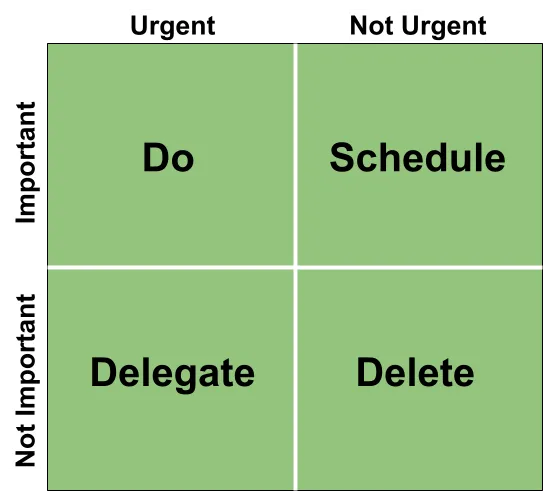
It’s largely self-explanatory. You should do and schedule important things, and try to delegate or delete unimportant things, depending on their level of urgency.
It’s wrong. This is the improved Eisenhower Matrix:
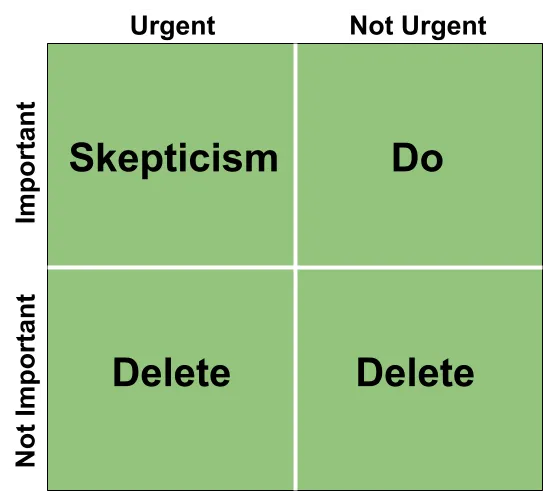
For most of us, our “daily tasks” populate the urgent/important square. For example, the ticket in the queue from a very unhappy user who needs the local restaurant website unblocked from the firewall — yesterday. You might, correctly, deduce that that is not actually important. But, perhaps less intuitively: most of what you are told is important — even by your boss — is not. First, ask, what is actually the worst thing that can happen if you either don’t do or are late in doing the thing you’re told to do? Usually, not much. Second, think beyond your immediate station. Think beyond you and your team. Think about your department. Think about your organizational unit. Ask yourself: what can you do to make the biggest positive impact for as many people as possible? Another way to think about this is to think about how you can make your boss, your boss’s boss, as well as their boss, look good.
You might say, “Well, I don’t have the time or resources to do that.” Maybe not right now you don’t. But what’s stopping you from making the time? From acquiring/befriending the resources you need to make that happen? Other than your day job?
And that’s my thesis. Shirk your duties. The unimportant ones. The pointless ones. The things that don’t move the needle. The things that add no long-term value. After all, if you skip those pointless tasks and solve the meaningful problems, the pointless things often just… fade away. The crap we’re told to spend our days shoveling might just disappear if we install a toilet.
Install a Toilet
Okay. We both agree: your time is best spent not shoveling away at an endless pile of … meaningless work. This begs the question: what SHOULD you spend your time on? Here’s a hint: if the ditch keeps filling with crap, the answer is not to become a faster digger!
If you’re unfamiliar with the public accountant depiction of rolling “poop”, I implore you to review the following image:
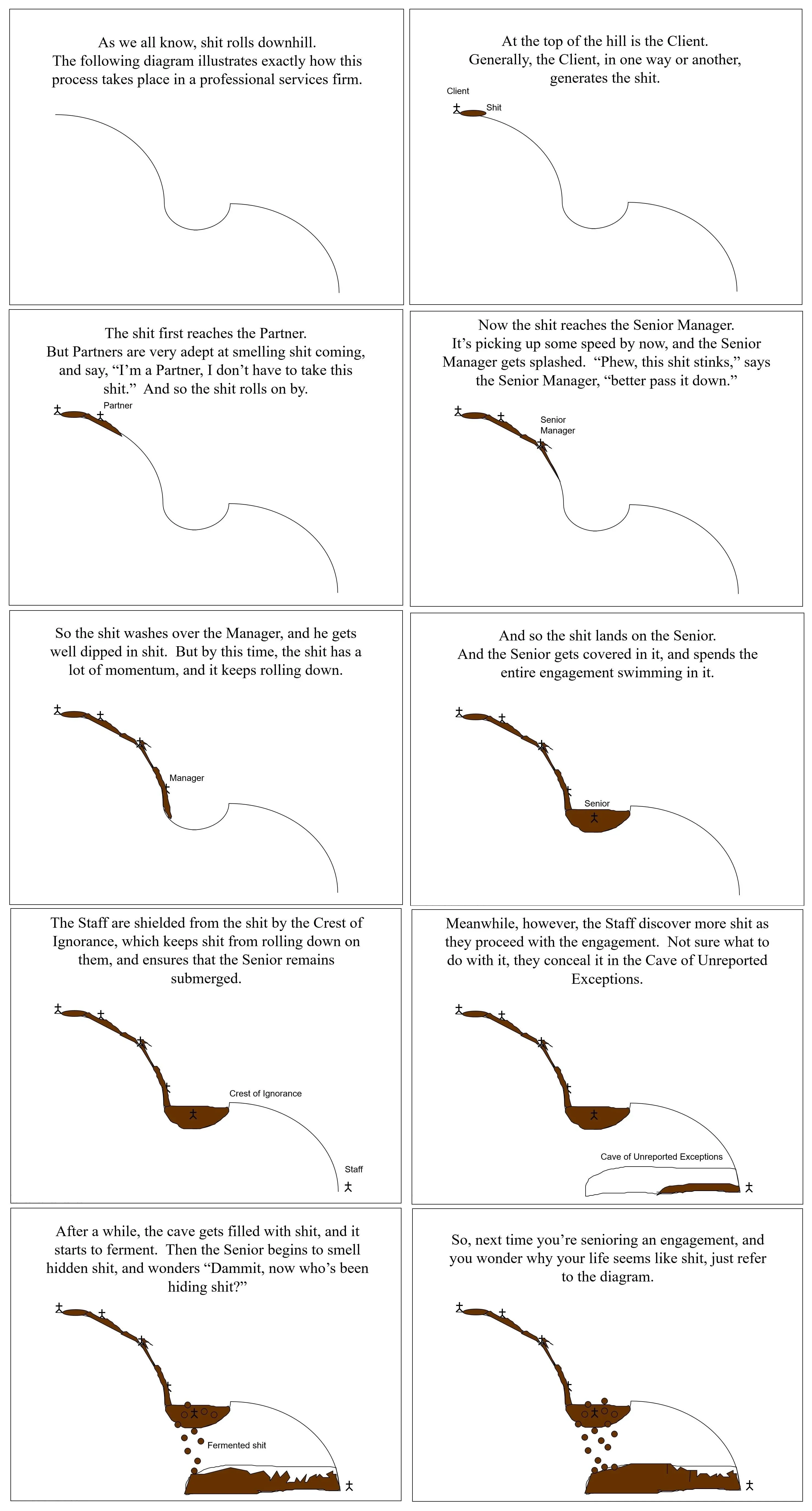
Chances are, you can relate to this image. For your org, you can probably easily define what the “poop” is and point to exactly where you and your coworkers are represented in the picture. Your task? Try to mitigate the problem as far upstream as you can. In an ideal world, that produces the following result:
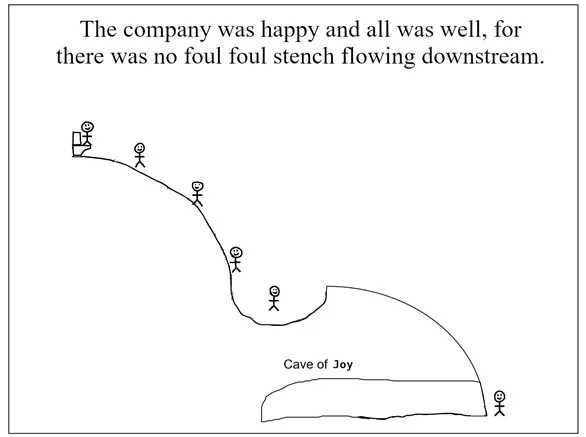
It’s easier said than done. In my experience, fixing problems upstream is generally blocked by knowledge and relationship gaps. Both of them can largely be resolved in the same way: talking to people. Don’t understand how something Bob built works? Go ask Bob! Even if he’s on another team. If Bob is not talkative, talk to his coworker, Alice. If all else fails, find documentation that describes the thing that Bob built — that’ll at least remediate the knowledge gap.
Relationship issues can be harder to figure out than knowledge gaps — particularly in the age of AI systems plugged into our corporate wikis and GitHub repos. Sometimes, it’s just a matter of befriending someone well enough to trust you to make a change. More frequently, as I’ve observed numerous times, the relationship issue is more structurally intrinsic: an elite old guard of oldheads may be very opinionated that the status quo is holy and must be preserved. They may have been revolutionaries in their prime time, but since then, they have become staunch reactionaries. After all, their status is staked upon the notion that the status quo — the one they built — is good.
There’s no one-size-fits-all approach to the problem of a self-correcting status quo. Sometimes, it’s necessary to displace the old regime. Other times, you just need to have some Crucial Conversations. Maybe you need to create and refine your solution, in secret, as a skunkworks project to be presented to those above the heads of your local Old Guard representative. Almost always, though, it’ll involve a lot of talking.
And Don’t Get Fired
It’s easy to say, “take chances, make mistakes, and get messy!” when you’re a well-regarded rockstar. But what if you’re not well-regarded? What if you’re not a rockstar? Well, even Mick Jagger has to sit through meetings. I’m not saying “don’t shovel the crap,” I’m saying, “shovel as little as you can get away with” — so that you can focus on bigger, better, and more important things.

You didn't forget Miss Frizzle's most important advice, did you?
A Message for Managers
Managers, leaders, and supervisors of the world, hear my prayer: Let not the experimenters, tinkerers, innovators, and free thinkers of our glorious workforce be punished for spending an hour or two — or even THREE! — on trying to improve their station or make the organization better. There can be no improvement without doing things differently.
And, please, recognize that this comes in many flavors and forms. Sometimes, zig-zagging from cubicle to cubicle, striking up a conversation at every stop along the way to a cup of coffee, is the most straightforward and best way to build cross-functional relationships. In my grandpa’s day, they called that “cross-pollination.” Other times, it involves heads-down time reading documentation. Someone else’s documentation. About how they do things. It can even involve… new ideas. Or old ideas — made new!
Just, please, stop hounding people about trivialities and metrics at the expense of all else. Metrics are just guestimates on how to measure how good we are at the current way of doing things. There is no metric (at least, no good one) for “innovation,” or “collaboration,” or “revolution.” And the metrics defining how good we are at the future way of doing things don’t exist yet.